

Northern Suburbs Branch
As most of us are aware, animal and plant biodiversity and the associated ecological processes underpin the health of our environment and therefore its ability to support human needs. Species diversity is changing globally and locally, but the complexity of ecological communities hampers a general understanding of the consequences of animal and plant species loss on ecosystem functioning.
Charles Darwin first examined the role of digging animals in transforming environments in the late 1800s in his book on worms. He posited that the physical impacts of individual organisms that are seemingly insignificant by themselves could potentially accumulate to transform environments. Our speaker, Dr Leonie Valentine, presented some of the research she and her collaborators have undertaken on the role of fauna in ecosystems, in particular those mammals that dig. Leonie highlighted what incredible ecosystem engineers (bioturbators) they are. In Australia, we have approximately 29 digging marsupials and monotremes; mostly these species belong to the bandicoot, bettong and bilby groups but include potoroos, wombats and echidnas.
So, how much can these Australian digging mammals dig? Some of the research work undertaken looked at soil turnover, where the differing weights of the digging animals was factored in; and for animals that create burrows as well as foraging pits—such as the Greater Bilby (Macrotis lagotis)—they can turn over substantial amounts of soil; similarly for wombats. A lot of the diggers though, do not burrow; instead they create foraging pits. Cumulatively they have the capacity to turn over surprising amounts of soil—but a lot more research is needed in this field just quantifying how much soil turnover foraging animals can create. However, recently a student examined soil turnover for echidnas and estimated
that they could turn over more than 200 m3 per year per animal. One of Leonie’s students, Lauren Halstead, based at Deakin University, has examined soil turnover rates of Eastern Barred Bandicoot on Churchill Island and she’s estimated that they are turning over a number of tonnes of soil per year. Leonie and her collaborators have been interested in looking at the foraging pits of Quendas (Isoodon obesulus fusciventer) (below) and establishing how they might play an important role in ecosystem engineering in Australia.
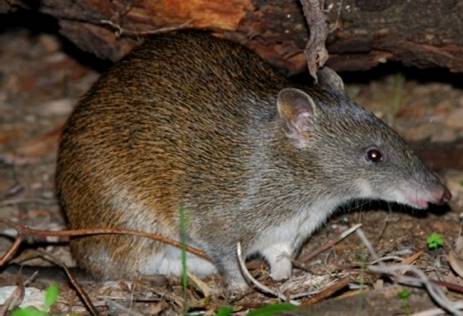
Based on research to date at the Craigie Bushland, each dig of a Quenda displaces 965g of soil. Assuming that there are four Quenda per hectare and each Quenda has 34 digs per day, this equates to approximately 12 tonnes of soil displaced per hectare per year. From this work the research identified how Quenda digging changes soil moisture by increasing rainfall penetration of the soil. Soils in Western Australia generally have high soil hydrophobicity (repelling water) and therefore the decrease in the number of Quenda will have significant effects on infiltration. The research to date also indicates that seedlings grown in soil manipulated by Quenda grow bigger. Digging mammals really are important in our ecosystem processes.
Once upon a time there were a lot of mammal diggers—not just in terms of their distribution, but also in terms of their abundance. Anecdotal evidence indicates that they used to be in very high numbers. When Europeans arrived in Australia, we added many pressures to the populations: we hunted them, we destroyed their habitat and we altered burning patterns, often creating very broad scale, big fires. In addition, we added predators. All of this resulted in reduced digging animal numbers and distribution.
So how are we meant to manage these novel mammal assemblages, especially if we want to restore ecosystem processes? Leonie highlighted that we know that reintroducing digging mammals can assist in ecosystem restoration. However, this strategy cannot operate in isolation. There are techniques that require simultaneous implementation. We need a range of tactics to reduce invasive predators, while removing invasive herbivores as well as altering our habitat management and, where appropriate, letting understory vegetation come back to provide Quenda habitat. It will be increasingly important to gain and maintain public support—there will not be a simple solution and it will take continual management!
Graham Ezzy