
NSB August Meeting Report

Radio-tracking is used for real-time survivorship and movement monitoring of translocated animals.
Photo: Saul Cowen
Kelly Rayner, who spoke to us in August, is a member of the Department of Biodiversity Conservation & Attraction (DBCA) translocation team working towards reintroducing native mammals to Dirk Hartog Island, Western Australia’s largest island (approx. 63,300ha).
The island lies at the boundary of two biogeographical regions: the temperate bushlands of the Southwest region and the dry grasslands of the Central Arid region. Consequently the island was originally inhabited by mammals from both regions. However, due to extensive grazing by sheep and goats and predation by introduced cats, 10 of those 15 mammal species became extinct. The only survivors were two rodents, one Dunnart and two bats.
Destocking of the island’s 5,000 sheep began in 2007 and was complete by 2016. Fifteen female goats fitted with satellite collars led trackers to larger herds, which were progressively culled. In 2017 Dirk Hartog became the largest island in the world from which goats have been successfully eradicated.
Feral cats fitted with GPS collars enabled the cat team to determine the cats’ daily activity patterns and estimate detection probabilities. This information lead to an effective strategy for locating and eradicating the cats. The last cat detection was in 2016 and it is expected that the island will be declared cat-free in September.
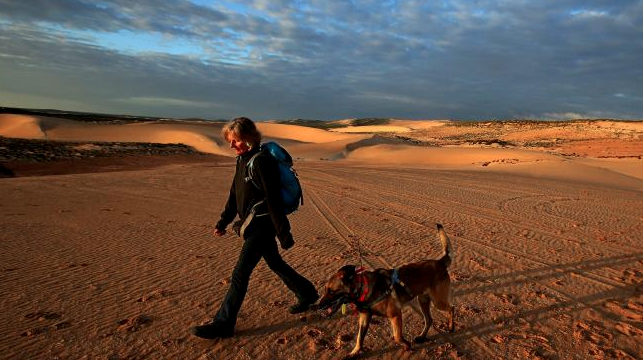
Sniffer dogs, trained to respond to cat scent were on method used to confirm eradication of cats. Photo: News Corp Australia, Colin Murty
To determine which mammals originally inhabited the island, records of “sub-fossils”—mostly taken from cave deposits that were likely roost sites of owls and birds of prey—were examined. It was decided that 11 species would be re-introduced over the next 12 years and two new species would be introduced, as the island provides an excellent opportunity to conserve locally occurring endangered species.
The reintroduction of mammals and a single species of bird will entail recreating an ecosystem as similar as possible to the original. That’s not an easy task, as it means replicating a process in just over a decade that would naturally take thousands of years to occur. As the goal of the project is to restore a functional ecosystem, multiple species which may compete with each other for resources or may prey upon each other will be put together. Doing this in a way that results in all species surviving is the experiment that the team and its successors will be looking to complete in the next 12 years.
The animals to be reintroduced are: Boodie (Burrowing Bettong), Woylie (Brush-tailed Bettong), Marl (Western Barred Bandicoot); four rodents, Greater Stick-nest Rat, Shark Bay Mouse, Desert Mouse and Heath Mouse; three carnivores: the Dibbler, Brush-tailed Mulgara and Chuditch (Western Quoll) and one bird, the Western Grasswren. In addition, Banded Hare-wallabies and Rufous Hare-wallabies will be introduced to the island for conservation purposes. The animals will be sourced from populations throughout Western Australia, with one species potentially coming from the Franklin Islands, South Australia.

Releasing the first Banded Hare Wallabies. Photo: Richard Manning
Translocation trials began in 2017 with the release of 12 Rufous Hare-wallabies (RHW) and 12 Banded Hare-wallabies (BHW) (Above), all sourced from nearby Bernier and Dorre Islands.
The release has been extremely successful with only one death (a RHW). All the animals have put on weight and some have successfully mated, with 16 pouch young recorded. This year it is planned to translocate a further 40-80 BHW and the same number of RHW.
The ecological restoration appears to be progressing very well with 42 per cent of the island’s vegetation having either increased moderately or significantly since destocking commenced.
Don Poynton