

DARLING RANGE BRANCH JULY MEETING REPORT.
Our speaker was Andrew Moore, drone pilot and scientist. As a child, Andrew was obsessed with seeing things from an aerial perspective and was also fascinated with nature. His passion for drones has stemmed from these childhood interests, combined with his father’s involvement with remote-controlled planes (generally accompanied by Andrew), which evolved into radio-controlled planes and then into drone technology.
The use of drone technology in nature projects began by monitoring illegal logging of orangutan habitat in rainforest areas of Indonesia. Orangutan nests are often at the top of trees and difficult to locate from the ground, but easily seen from above. The amazing clarity of the photography and the ability to easily zoom in on the images made it easy to demonstrate that the logging was taking place in the areas containing orangutan nests. Drone technology has also been used to track whales in the oceans and animals in the African savannah.
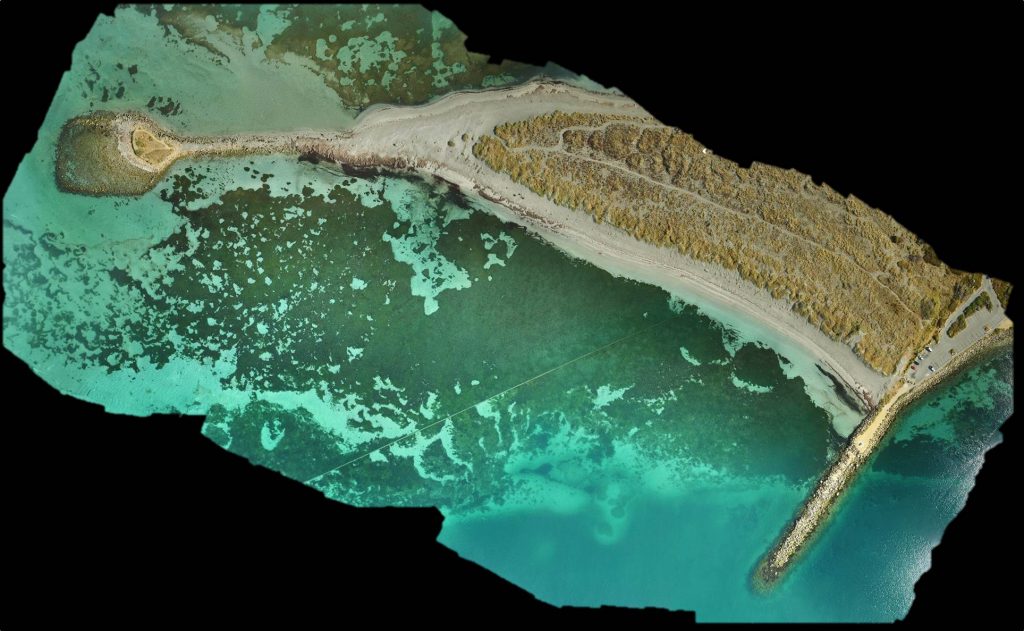
Andrew’s first use of drone technology was in a project to monitor seagrass and mangroves in Shark Bay. Previously, the monitoring was done manually by people manually placing quadrats in an area, recording the GPS position and then photographing that location. This was then repeated at intervals. Not only was this extremely time-consuming and expensive, but environmental damage was caused by the people walking on mangrove aerial roots. A drone, on the other hand, can cover a greater area in more detail, with no impact on the natural environment and higher quality images, in as little as 15 minutes.
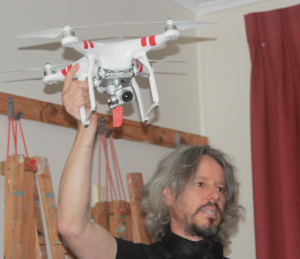
Andrew with drone (above) used for seagrass monitoring at Shark Bay and Woodman Point(below)
 Andrew gave us a history of the development of drones, which continues at an amazing pace, predominantly in China. Drones are becoming more stable, smaller and have more powerful cameras and longer-life batteries. The technology changes so fast that a drone is superseded within six months by a better model. They have come down in price from about $100,000 to about $1200 for a good model or $2000 for a compact professional model with an excellent camera. The battery is the most important part of all drones. They are now used for photography, video, mapping and 3D imaging.
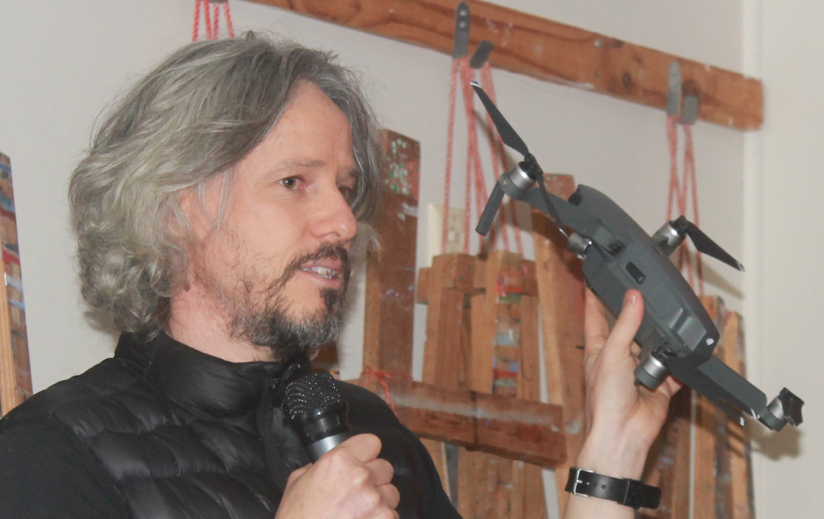
Andrew with latest smaller model drone (all pictures R. Green)
Safety aspects include keeping the drone in your line of sight, keeping it 30 metres away from people and away from planes and airports, ensuring your battery has enough life, and not operating in temperatures above 50 degrees. Used correctly, drones are quick, economical, accurate, safe and powerful.
Other projects Andrew has used drones for include:
- monitoring forest areas
- assessing the damage done to Vanuatu by Cyclone Pam in 2016, so the worst affected areas could be assisted first;
- the campaign against Roe 8 (now the Community Wildlife Corridor), in which beautiful drone video footage over the area was sent to media outlets
- assisting Simon Cherriman with his Wedge-tailed Eagle research.
Andrew ended his interesting and enjoyable talk by showing us some beautiful examples of his work, then fielding questions from the audience. His stunning video footage can be seen by clicking on the logo. ↓
 Shelley Campbell