

NS Branch 19 April 2023
Our speaker for April was Paul Brown, who fills the voluntary role of Works Co-ordinator for the Friends of Perry Lakes (FOPL).
It was surprising to learn that despite the popularity and endearing features of the Perry Lakes Reserve, a friends’ group only existed from November 2021. The group quickly built a membership of around 90 people in its first year, made up almost exclusively of local residents, and currently has approximately 50 members.
Like most friends’ groups, the work undertaken by FOPL’s volunteers revolves around removing environmental weeds – 87 species having been recognised – and revegetating the various landform types around the two Perry Lakes. The group is using the rehabilitation of Lake Claremont as a model. This means planting the lake floors and a buffer around each lake for the wildlife while providing scenic views for the many visitors. In 2022 the Town of Cambridge planted more than ten thousand reeds strategically placed to filter the water entering the West Lake from the recently completed diversion channel from the Herdsman Main Drain.

Map by Paul Brown
A smaller area was planted at the northern end of East Lake to filter the water entering the lake by an underground pipe connecting the two lakes.
At the same time, volunteers from FOPL helped plant more than five thousand dry-land plants at a density of two plants per square metre, which Paul considers too dense given many of the species grow to a width of two metres. The estimated survival rate is just greater than 50%.
The drying climate and removal of groundwater from the 1960s to recently resulted in the drying out of the lakes and their separation from the groundwater aquifer, thereby creating perched lakes which could only be replenished by rainfall and runoff.
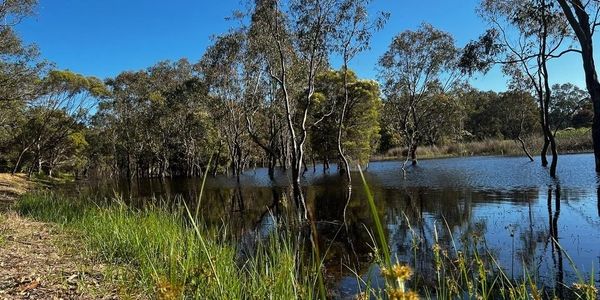
Recharge, using water diverted from Herdsman Lake, along with better than the short-term average rainfall in 2021 and 2022, meant the lakes were full for the first time since 1993. But Paul left us with the question, what should the new “natural” level be? The target of 3.8m AHD (Above Height Datum = Sea Level) would result in both lakes being completely covered. In contrast, a level of 3.2m AHD with periodic flooding would result in the beneficial dry and wet cycles that some riparian flora requires.

FOPL holds its working bees at 9 am on the third Sunday of the month. Anyone interested in becoming a volunteer would be most welcome. Friends of Perry Lakes website
Paul, who now lives in Busselton, completed his presentation by revealing his other passion -‘Gorilla Weeding’. His golden rule is: I am not here to control weeds! I am here to ERADICATE wicked environmental weeds, completely clearing them from my target sites.
Paul began his mission by recording environmental weed species and their locations along the wetlands and foreshore in Busselton. His records show 107 weed species found at 298 wetland locations and 92 foreshore locations. He has removed almost 50,000 weeds from 47 locations in the last two years.
While Paul prefers to work alone, the world needs more Pauls.
Don Poynton