

The Branch Chairperson filled in for a missing speaker by showing members how microfossils can be used to determine:
- The age of a rock
- Where it came from
- If it could produce oil and gas, and most importantly
- Has it produced oil or gas?
Microfossils are the remains of microscopic single-celled organisms and other once-living flora and fauna. Foraminifera (usually shortened to forams), pollens and spores, and conodonts are the microfossils most commonly used by explorers to answer these questions.
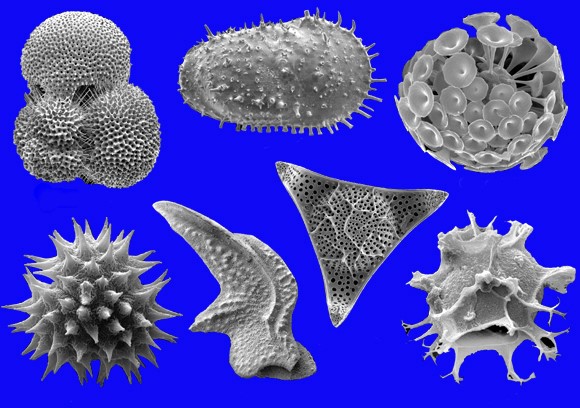
Pollen (top left), Foraminifera (top right) and Conodont (second row left). From The Federal Institute for Geosciences and Natural Resources. www.bgr.bund.de
Forams are exclusively marine and are most useful for determining the age of rocks from the beginning of the Cretaceous, 166 million years ago (166 mya) to the present. Forams can also be used to determine the depositional environment of the sediments which form the rock in which they are found. The ratio of planktonic species to benthonic species increases with water depth and benthonic species diversity increases away from shore. They can also be used as palaeoclimate indicators as the oxygen isotope ratios in their calcium carbonate shells are indicators of water temperature.
Although spores and pollens can be used to date rocks younger than the Cretaceous, in Australia they are more often used for dating rocks from the Carboniferous period, starting 354 mya through to the end of the Jurassic period, 145 mya.
Conodonts, “tooth-like” microfossils, are used to date even older rocks. They have been found in rocks as old as the Cambrian (550 mya) but are most abundant in rocks from the Devonian period (416-350 mya). They are resistant to erosion because they are made from hydroxyapatite, a phosphate mineral that is a major and essential component of vertebrate bones and teeth. Conodonts were studied for more than a century before consensus was reached that they are the “teeth” of ancient soft-bodied lamprey-like creatures.
Petroleum is the end product of the decomposition and thermal alteration (usually due to increased burial) of algae, plankton and other organic matter that have been deposited contemporaneously with the mineral components of sedimentary rocks. During the process, the organic matter is converted to kerogen, a mixture of organic chemical compounds such as complex proteins and carbohydrates. These progressively break down into simpler compounds of hydrogen and carbon (and minor amounts of nitrogen, sulphur and oxygen), which is why oil and gas are often referred to as hydrocarbons.
The type of kerogen formed and its end product reflect the type of organic matter: e.g. alginate, a kerogen rich in marine algae, produces oil, while vitrinite, a kerogen derived from fibrous and woody terrestrial plant fragments and amorphous humic matter, is most likely to produce gas.

Sedimentary rocks containing kerogen are known as potential source rocks. To be a source rock for oil or gas the amount of organic carbon in the kerogen must make up at least one percent by weight of the rock. The best source rocks contain two to greater than ten percent organic carbon. However for source rocks to generate oil and gas they must be buried to a depth where the temperate is high enough to cause the chemical reactions that break down the complex compounds.
Oil starts to be produced at around 60°C and gas at around 100°C. Above 250°C all the compounds will have been converted to just carbon.

Forams, spores and pollens and conodonts all undergo colour changes, becoming darker, as the temperature increases. These alterations (known as Thermal Alteration Indices), are used to tell explorers whether their source rock has yet to reach (immature), is in (mature), or has passed through (over-mature) the oil and gas windows.
The French naturalist Francois Peron was the first person to collect a source rock in Australia when he picked up specimens of algal-rich rocks in the Mittagong Valley, NSW in 1802, while the first discovery of oil in Australia was bituminous material found in a water well dug by the crew of HMS Beagle in the tidal reaches of the Victoria River, NT in 1839. The first well drilled for oil was at Salt Creek on the edge of the Coorong, SA where dried strands of the green algae Botryococcus braunii, which secretes hydrocarbons naturally, were mistaken for dried oil.
Don Poynton