

Main Club 15 – 17 October 2021
The WA Naturalists’ Club has a cottage on Cooleenup Island at Yunderup. The Yunderup Field Station (or Nature Observatory) has been the base for many field trips since it was built in 1984 (officially opened —1985). Cooleenup is one of several low-lying islands in the delta where the Murray River connects with the Peel Estuary.
Visiting Cooleenup Island is an adventure, accessible by boat or kayak but not by car. On this occasion, six members took part (and another member joined for part of Saturday). It was their first time at the island for the three members, ferried there from the South Yunderup boat ramp by skipper Roman Mandyczewsky and his dinghy. The old fibro cottage was home for a few days as we explored the island from east to west on a series of walks traversing its sandy flats and samphire marshes.
Birds were a highlight of our stay. Throughout the weekend, we recorded 38 species. Yellow-billed Spoonbill (Platalea flavipes) and White-faced Heron (Egretta novaehollandiae) were seen nesting in a tall pine tree in the eastern part of the island. We also saw Osprey (Pandion haliatetus) and Pelicans (Pelicanus conspiculatus) over or on waters adjacent the island. Other species of note were the Splendid Fairy-wren (Malurus splendens), Nankeen Night-heron (Nycticorax caledonicus), Striated Pardalote (Pardalotus striatus), White-browed Scrubwren (Sericornis frontalis) and Sacred Kingfisher (Todiramphus sanctus). In the cottage library, we found an article from The WA Naturalist (Vol. 11, No. 7, August 1970) on a 1967 excursion on the island when 74 bird species were recorded.
Invertebrates tend to be overlooked, despite their critical role in ecosystems. At Cooleenup, they made their presence felt, with clouds of mosquitos encountered in parts of the island. On warm nights we had many flies and beetles join us inside the cottage, massing around the ceiling lights, the spent husks of some peppering the table around which we sat.
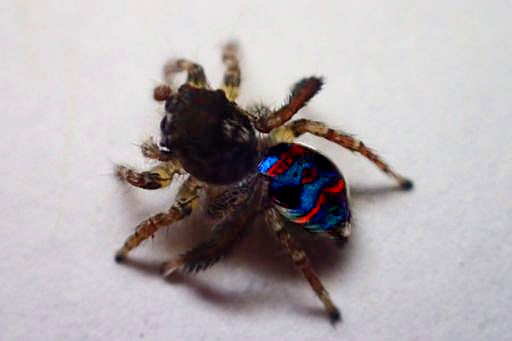
We found Peacock Spiders in a few locations on our walks, including Maratus pavonis on Cooper’s Mill (which dates from 1846) at the western edge of the island and Maratus speciosus on a palm (unidentified species) at picnic area nearby. Brightly coloured but quick-moving, they proved a challenge to photograph well, though young entomologist, Patrick Wake, managed to capture them.
Peacock Spider. – Image by Patrick Wake
Over the two days, Jolanda Keeble focused on collecting plant specimens for an update of the island’s herbarium. Small flowering herbs were abundant in the moist soils of the island. In total, 66 species were recorded on this excursion. These included six not previously noted on the island: Dichopogon preissii, Euphorbia terracina (Carnation weed), Lawrencia spicata, Levenhookia pusilla (Midget stylewort), Microtis media, Stylidium longitubum (Jumping Jacks).
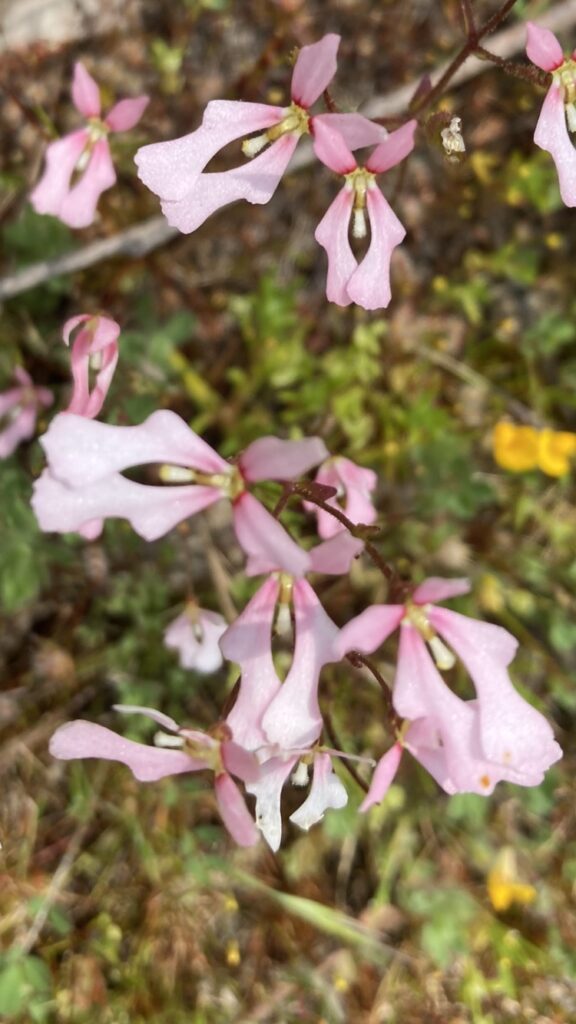
The clusters of flowering Stylidium plants (pinks and white) were the weekend’s highlight. The flora list for the island runs to 306 species, including 107 weeds. Two weeds we saw too many of were Black Flag (Ferraria crispa), which seems to be spreading and Watsonia (Watsonia meriana var. bulbifllifera) which occupies large patches; we hand pulled some on our walks but a more concerted effort is needed to control them.
Stylidium calcaratum Image by David Wake
Lucy and Roman Mandyczewsky mentioned the long term inhabitant of the cottage, a goanna living on the roof.
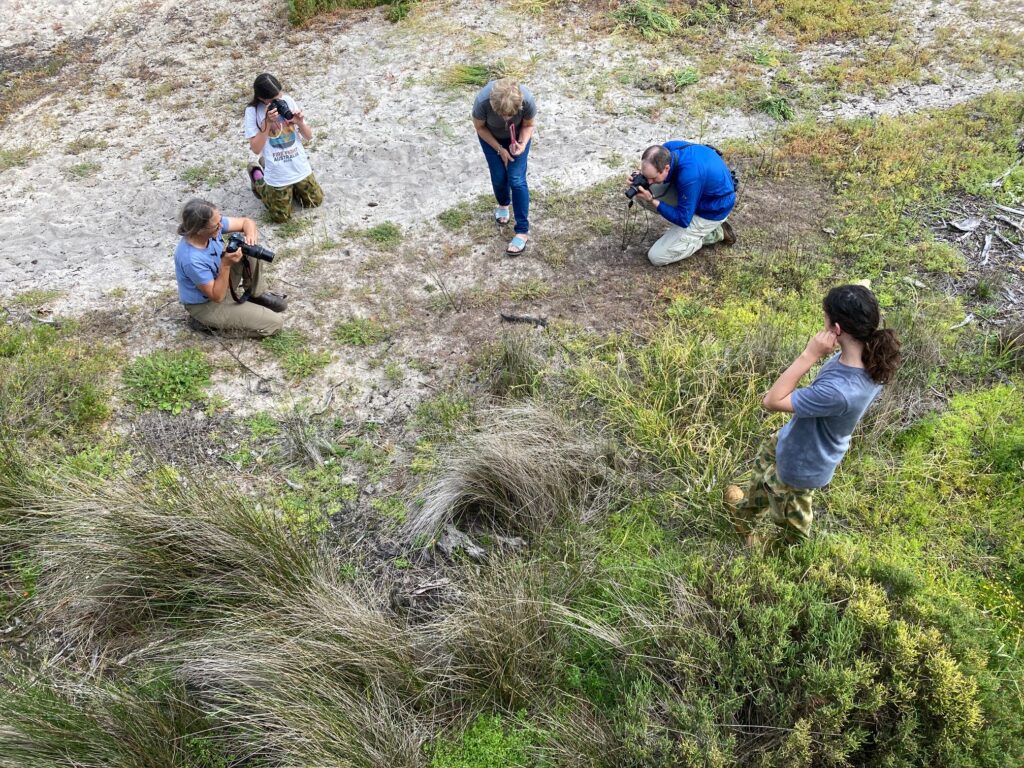
We got to meet the goanna up close when it clambered down the drainpipe and remained on the sand patch outside. We gathered around to take a look and take photos.
A group of people taking photo of Varanus. Image by David Wake
We identified it as the Black-headed Monitor (Varanus tristis). After the photoshoot, the goanna climbed back up to the cottage roof.
Reports of earlier excursions are worth a read (available on the Club’s website),
covering flora and fauna observed and some discussing the condition of the island and the impact of changes in the adjacent estuary.
Pictures of many of the plants and animals have been uploaded to iNaturalist and can be viewed (without a login)
Members’ continued involvement in excursions will help us monitor change over time, necessary in seeking appropriate management.
David Wake